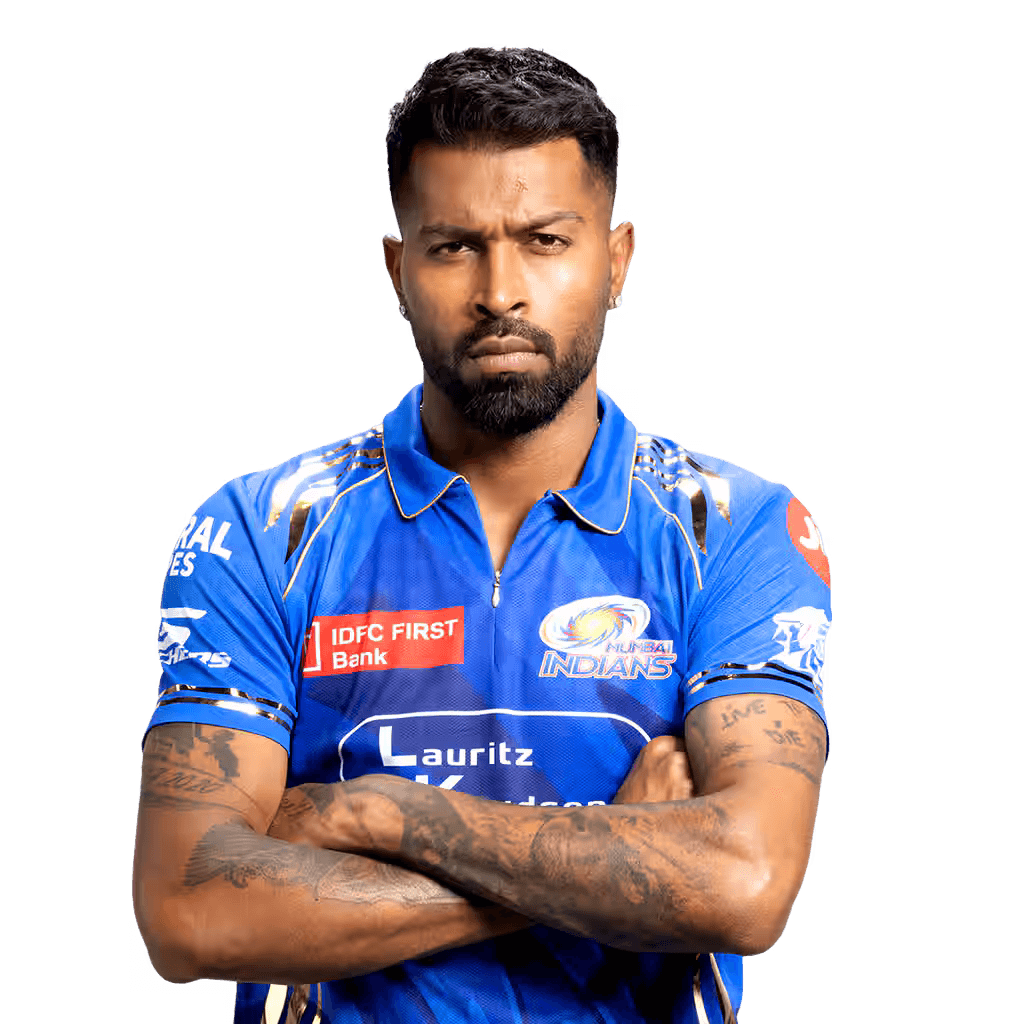
Hardik Himanshu Pandya
🏏 Batting: right hand | 🎯 Bowling: right arm fast
# Hardik Pandya - Short Bio/Summary **Hardik Pandya: India's Dynamic All-Rounder and Match-Winner** Hardik Himanshu Pandya, born on October 11, 1993, in Choryasi, Gujarat, is one of India's most explosive all-rounders in modern cricket. A product of Baroda's cricketing nursery, Hardik rose from humble beginnings—his father shut down his business to support his sons' cricketing dreams—to become an indispensable part of India's white-ball setup. **Quick Facts:** - **Role:** All-rounder (Right-hand batsman, Right-arm fast-medium bowler) - **Major Teams:** India, Mumbai Indians (2015-2021), Gujarat Titans (2022-present) - **IPL Titles:** 6 (5 with MI, 1 as GT captain) - **International Debut:** T20I - January 2016, ODI - October 2016, Test - July 2017 **What Defines Him:** Hardik brings fearless batting with the ability to accelerate instantly, complemented by smart fast-medium bowling in the 135-145 kmph range. His skiddy deliveries and effective variations make him a crucial bowler in pressure situations. As a batsman, his power-hitting and improving shot selection have made him one of the world's premier finishers. **Career Highlights:** - Led Gujarat Titans to IPL title in their debut season (2022) - Five-time IPL champion with Mumbai Indians - Key performer in India's white-ball campaigns across World Cups - First Indian to score two fifties batting at No. 8 in a Test match (Trent Bridge, 2018) **Challenges & Comebacks:** Hardik's career has been marked by significant injury battles, particularly his back surgery in 2019 that threatened his bowling career. His successful comeback to all-round cricket showcases remarkable mental strength and dedication to rehabilitation. **Legacy:** Beyond statistics, Hardik represents a new era of Indian cricket—confident, stylish, and unafraid to express individuality while remaining a committed team player. He solved India's long-standing search for a genuine fast-bowling all-rounder, providing crucial team balance. His leadership with Gujarat Titans proved his tactical acumen, while his impact on and off the field continues to inspire the next generation of Indian cricketers. At 31, Hardik Pandya remains central to India's quest for ICC trophies and continues to be one of cricket's most valuable all-rounders—a true match-winner with both bat and ball.
From Baroda's Streets to the World Stage: The Hardik Pandya Story
You know, when we talk about Indian cricket's modern era, certain names immediately spring to mind—players who've changed the game, who've brought that X-factor we so desperately craved. Hardik Pandya is one such cricketer. Not just because he can bat like a proper batsman and bowl those sharp pace deliveries, but because he arrived with an attitude, a confidence that frankly, Indian cricket needed.
Hardik Himanshu Pandya was born on October 11, 1993, in Choryasi, a small town in Gujarat, but his cricketing journey truly began in Baroda (now Vadodara). And here's the thing about his early life—it wasn't easy. Not by a long shot.
His father, Himanshu Pandya, ran a small car finance business, and the family wasn't exactly swimming in resources. There were times when young Hardik and his brother Krunal would share cricket equipment, practice in whatever space they could find, and dream of playing for India. The Pandya household wasn't one where cricket was a hobby; it was an obsession, a pathway out, a dream worth sacrificing for.
What I find fascinating about Hardik's early years is the sheer determination his father showed. Himanshu Pandya made a decision that many parents wouldn't dare to make—he shut down his business and moved the family to a rented apartment so both his sons could focus entirely on cricket. Imagine that risk! That leap of faith! The family lived in a modest two-room apartment in Baroda, and cricket became their everything.
Young Hardik trained at the Kiran More Academy under the watchful eyes of coach Jitendra Singh. From the very beginning, there was something different about him—a fearlessness, an aggressive intent that stood out even in practice sessions.
Now, let's talk about domestic cricket, because that's where reputations are truly built in India. Hardik made his first-class debut for Baroda in the 2012-13 Ranji Trophy season. He was just 19 years old, raw, full of potential, but also unpolished—like a diamond that needed cutting.
In those early domestic matches, Hardik showed glimpses of what he could become. He wasn't just a bits-and-pieces cricketer; he could genuinely bat in the middle order and bowl quick enough to trouble batsmen. But consistency? That took time. The domestic circuit is brutal—it tests your technique, your temperament, your hunger. And Hardik went through that grind.
What impressed me about his domestic career was his willingness to evolve. He worked on his fitness obsessively, transformed his body from that of a promising youngster to an athletic specimen capable of handling the rigors of international cricket. By the 2015-16 season, he was making significant contributions for Baroda, and the selectors were taking notice.
Here's where the story gets really interesting. The Indian Premier League has been a game-changer for Indian cricket, hasn't it? It gives young players exposure, experience, and most importantly, confidence. In 2015, Mumbai Indians picked up Hardik Pandya for his base price of INR 10 lakh. Ten lakh! Look at what he became after that.
Under the mentorship of Rohit Sharma and the guidance of coaches like John Wright and later Mahela Jayawardene, Hardik blossomed. Mumbai Indians gave him the freedom to express himself, to play his natural game without fear of failure. And boy, did he grab that opportunity with both hands!
The 2015 IPL season saw flashes of brilliance—big hits, crucial wickets at important moments. But it was in the subsequent seasons that Hardik truly established himself as one of the IPL's most valuable players. His ability to finish innings, to bowl those tight overs in the death, to take stunning catches in the outfield—he became the complete package.
I remember watching him in the 2017 IPL final against Rising Pune Supergiant. The pressure was immense, Mumbai Indians needed something special, and Hardik delivered with both bat and ball. That's when I knew—this guy has it, that champion's mindset.
Hardik's international debut came in January 2016 during a T20I against Australia in Adelaide. He was 22 years old, playing in front of a massive crowd in a foreign country, and what did he do? He showed no nerves whatsoever. That's Hardik for you—confidence bordering on swagger.
His ODI debut came shortly after in October 2016 against New Zealand, and he marked it with a brilliant 27-ball 30 in a challenging chase. But it was in that series that we truly saw what Hardik brought to the table. He wasn't just filling a spot; he was solving a problem that had plagued Indian cricket for years—the lack of a genuine fast-bowling all-rounder.
The Test debut came in July 2017 against Sri Lanka in Galle, and he announced himself with a stunning 50-ball 50 in the first innings. His ability to attack even in Test cricket, to play those audacious shots when the team needed quick runs, was refreshing.
Now, let's analyze Hardik's batting because it's evolved tremendously over the years. When he first burst onto the scene, Hardik was primarily a big hitter—someone who could clear the boundary with ease, who had that raw power. His batting was instinctive, aggressive, sometimes reckless.
His strength lies in his ability to hit the ball to all parts of the ground. That bottom-hand dominance gives him tremendous power on the leg side, and he's particularly devastating against pace bowlers once he gets going. The lofted shots over long-on and long-off, the pulls and the hooks—these are his bread and butter.
But what's impressed me in recent years is how he's added more strings to his bow. He's learned to build innings, to rotate strike, to play according to match situations. Look at his batting in the 2023 ODI World Cup—there was maturity there, a willingness to play the anchor role when needed while maintaining the ability to explode when required.
His technique against spin has improved significantly. Earlier in his career, quality spinners could tie him down, but he's worked hard on his footwork and shot selection. The switch hits, the reverse sweeps—he's added these to keep bowlers guessing.
The key to Hardik's batting is his hand-eye coordination and his ability to pick length early. He doesn't need a long time to get set; he can start hitting from ball one if the situation demands it. That's what makes him such a valuable asset in white-ball cricket.
When we talk about Hardik's bowling, we're discussing someone who bowls in the high 130s to low 140s kilometers per hour consistently—not express pace, but quick enough to trouble batsmen, especially with his skiddy trajectory.
What makes Hardik effective as a bowler is not just his pace but his variations and his cricketing intelligence. He understands match situations, knows when to bowl the hard lengths, when to take pace off, when to aim for the yorkers. His back-of-the-hand slower ball has become a potent weapon, especially in T20 cricket.
His bowling action is smooth, and that's partly why he can maintain accuracy even under pressure. Captains have trusted him to bowl at crucial moments—in powerplays, in the middle overs to break partnerships, and even in death overs when the game is on the line.
But here's the challenge Hardik has faced—injury management. Fast bowling takes a toll on the body, and being an all-rounder means you're doing double the work. His back injuries have been a recurring concern, and there have been phases where he's had to focus more on batting to manage his workload. That's been one of the ongoing narratives of his career.
After his back surgery in 2019, there was genuine concern about whether he'd be able to bowl regularly again. But Hardik showed incredible resilience, worked on his fitness and rehabilitation, and gradually returned to bowling. It wasn't always at full throttle, but he found ways to contribute.
Let's talk numbers and achievements because Hardik's career has been decorated with significant milestones:
ODI Cricket: Hardik has been instrumental in numerous Indian victories. His aggressive middle-order batting and handy bowling have made him a crucial component of India's white-ball setup. He's scored crucial runs in pressure situations and picked up important wickets when the team needed breakthroughs.
T20I Cricket: This is perhaps his strongest format. Hardik's strike rate, his ability to score quickly from the get-go, and his death bowling skills make him one of the world's premier T20 all-rounders.
IPL Success: Five IPL titles with Mumbai Indians (2015, 2017, 2019, 2020) and then leading Gujarat Titans to their maiden title in 2022—that's an incredible IPL resume. His performances in IPL finals have often been match-winning.
2022 T20 World Cup: His all-round performances were crucial to India reaching the semi-finals. He was consistently delivering with both bat and ball when the team needed him most.
ICC Rankings: Hardik has been ranked among the top all-rounders in ICC rankings across formats, a testament to his consistent performances at the highest level.
One particular achievement that stands out is his performance in England during the 2018 Test series at Trent Bridge, where he scored a magnificent 52 not out and 52 again in the second innings—becoming the first Indian to score two fifties batting at number eight in a Test match.
The captaincy chapter in Hardik's career has been fascinating to watch unfold. When Gujarat Titans was formed in 2022 and Hardik was announced as captain, there were skeptics. Could someone who'd never captained at the highest level lead a brand-new franchise?
The answer came emphatically in that very first season. Hardik led Gujarat Titans to the IPL title in their debut year—an unprecedented achievement. His leadership style was impressive: calm under pressure, tactically astute, leading from the front with his performances, and creating a positive team environment.
What I liked about his captaincy was the attacking mindset combined with smart game awareness. He wasn't afraid to make bold decisions—unusual bowling changes, aggressive field placements, promoting himself up the order when needed. He backed his players, gave youngsters opportunities, and created a winning culture from scratch.
His international captaincy opportunities have been limited but impactful. He's led India in T20Is, showing similar characteristics—aggressive yet balanced approach, backing his instincts, and maintaining that winning mentality.
The leadership qualities that stand out are his communication skills, his ability to stay calm in high-pressure situations, and his knack for reading game situations. He's also someone who leads by example—his work ethic, fitness standards, and commitment to the team are evident.
If there's one aspect of Hardik's career that's been challenging, it's his battles with injuries. The back injury that required surgery in 2019 was particularly concerning. For an all-rounder whose value lies in doing both disciplines, being unable to bowl regularly was a significant setback.
There was a period where Hardik was playing purely as a batsman in limited-overs cricket. While he still contributed with the bat, there was always that question: when will he bowl again? Will he ever be the complete all-rounder we knew?
The mental strength required to come back from such injuries cannot be understated. There's the physical rehabilitation, yes, but also the psychological challenge of regaining confidence in your body, of trusting that you won't break down again. Hardik went through that journey with remarkable determination.
His comeback to bowling in the IPL 2022 season was gradual but encouraging. He started bowling a couple of overs, then gradually increased his workload. By the time the T20 World Cup 2022 came around, he was bowling his full quota and doing it effectively.
What this journey taught us about Hardik was his mental resilience. Lesser players might have given up on the all-rounder dream and focused solely on batting. But Hardik knew his value to the team lay in his ability to contribute in multiple ways, and he worked relentlessly to get back to that level.
Hardik Pandya's impact on Indian cricket goes beyond statistics. He brought something intangible—a swagger, a confidence, an attitude that said, "We belong on this world stage, and we're going to dominate."
For years, Indian cricket had been searching for that fast-bowling all-rounder who could change game dynamics. Players had tried, but none succeeded at the international level like Hardik has. He solved a team balance issue, allowing India to play an extra bowler or batsman depending on conditions because he could do both jobs competently.
His presence in the team changed how opponents approached matches against India. Suddenly, there was someone at seven or eight who could take the game away in a matter of overs, and who could also bowl those crucial middle or death overs. That's a massive tactical advantage.
Beyond the skills, Hardik represented a new generation of Indian cricketers—confident, unafraid of expressing themselves, comfortable in their own skin. His fashion choices, his tattoos, his hairstyles—these might seem superficial, but they represented a cultural shift in Indian cricket. Players no longer had to fit into a certain mold; they could be individuals while still being committed team players.
His influence on young cricketers is also significant. Suddenly, being an all-rounder became aspirational again. Young players saw Hardik's success and thought, "I can do that too."
Hardik's IPL journey deserves a separate chapter because it's been nothing short of spectacular. His association with Mumbai Indians from 2015 to 2021 was incredibly successful—five title wins speak for themselves.
At Mumbai Indians, he was part of one of the most successful franchises in IPL history. He learned from the best—Rohit Sharma's captaincy, the mentorship of senior players, the professional environment. Those years shaped him as a cricketer and as a person.
The move to Gujarat Titans in 2022 as captain was a bold new chapter. Taking on the responsibility of leading a new franchise is immense pressure. The expectation is not just to compete but to build a winning culture from scratch.
What Hardik did with Gujarat Titans in that first season was remarkable. The team played fearless cricket, backed by smart strategies. They won the title in their debut year, with Hardik contributing significantly with both bat and ball throughout the tournament. His leadership was praised universally—he'd proven that he wasn't just a great player but potentially a great captain too.
His performance in IPL finals has been outstanding. Whether playing for Mumbai Indians or Gujarat Titans, he's delivered when it mattered most. That ability to perform on the biggest stages is what separates good players from great ones.
Off the field, Hardik is known for his flamboyant personality. His fashion sense, his love for luxury, his confidence in expressing himself—these have made him one of the most recognizable cricketers in India.
His personal life has also been in the spotlight. His relationship and marriage to Serbian actress Natasa Stankovic, and the birth of their son Agastya in 2020, brought him immense joy. He's spoken openly about how fatherhood changed his perspective and added new motivation to his career.
However, his personal life has also faced scrutiny and challenges, including a highly publicized separation. Through it all, Hardik has maintained his focus on cricket, using the sport as an outlet and continuing to deliver performances on the field.
What's commendable is how he's handled both success and setbacks with similar equanimity. The fame hasn't changed his work ethic; if anything, he's become more dedicated to his fitness and training regimen over the years.
As we look at where Hardik Pandya stands today, there's still much to achieve. The one thing missing from his trophy cabinet is a major ICC tournament win with India. The T20 World Cups, the ODI World Cup, the Champions Trophy—India has come close in several tournaments with Hardik playing crucial roles, but that elusive trophy remains the ultimate goal.
At 31 years old (as of 2024-25), Hardik is in his prime years as a cricketer. His experience, combined with his skills and fitness, makes him invaluable to the Indian team across formats, though his focus has primarily been on white-ball cricket in recent years.
The question of Test cricket remains interesting. Hardik has played only 11 Test matches, the last being in 2018. Does he have ambitions of returning to the longest format? Can his body handle the rigors of Test cricket along with his white-ball commitments? These are questions only time will answer.
His role in Indian cricket's leadership structure will also be fascinating to observe. Will he be groomed as a future captain across formats? His success with Gujarat Titans suggests he has the temperament and tactical acumen for the role.
When you assess Hardik Pandya's career holistically, you see a cricketer who's overcome tremendous odds to reach the pinnacle of the sport. From modest beginnings in Baroda to becoming one of India's most valuable players, his journey is inspirational.
What makes Hardik special is not just his skill set but his mindset. He plays without fear, backs himself completely, and has that rare ability to perform when the stakes are highest. Yes, there have been controversies, injuries, and setbacks, but he's navigated through them all with resilience.
For Indian cricket, Hardik Pandya represents possibility. He's shown that with determination, hard work, and self-belief, you can overcome any obstacle. He's also shown that being different, having your own style and personality, doesn't make you any less committed to the team's cause.
As a pure cricketer, his evolution from a raw, powerful hitter and fast bowler to a mature, thinking all-rounder has been remarkable to witness. He's added layers to his game while retaining that fearless approach that made him special in the first place.
The Hardik Pandya story is still being written, and if his past is any indication, the best chapters might still be ahead. For a country that's produced batting legends and bowling greats but historically struggled with all-rounders, Hardik Pandya is exactly what Indian cricket needed—a match-winner with both bat and ball, a leader, and a player who can change the course of a game in a single over.
That's the Hardik Pandya effect—impactful, inspiring, and absolutely indispensable.
IPL Champion Captain
IPL 2022
Led Gujarat Titans to IPL title in debut captaincy year
IPL Runner-up Captain
IPL 2023
GT runner-up under captaincy
