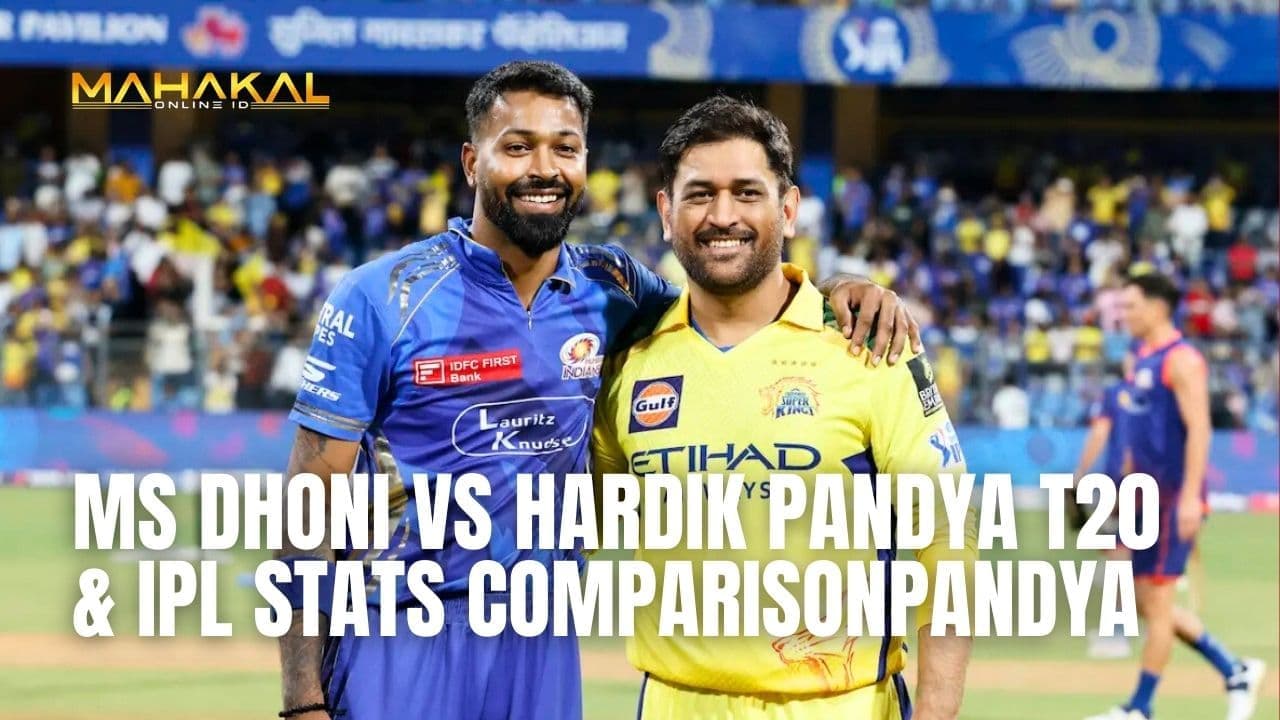
Hardik Pandya No. 1 T20I All-Rounder
Hardik Pandya creates history by becoming the first Indian all-rounder to achieve No. 1 ranking in ICC T20I rankings. Explore his journey, achievements, and impact on Indian cricket in this comprehensive analysis
 Mahakal Super admin
Hardik Pandya Creates History: First Indian All-Rounder to Achieve No. 1 T20I Ranking
When Hardik Pandya saw his name at the top of the ICC T20I all-rounder rankings, it wasn't just a personal milestone. It was a moment that validated years of struggle, sacrifice, and an unwavering belief in his abilities. More significantly, it was a historic achievement for Indian cricket, as Hardik became the first Indian all-rounder ever to reach the coveted No. 1 spot in T20I rankings.
Let that sink in for a moment. In a country that has produced legendary cricketers across generations, that has celebrated the brilliance of Kapil Dev, the elegance of Yuvraj Singh, and the versatility of Irfan Pathan, it was Hardik Pandya who finally conquered this particular peak. This achievement is not just about individual excellence but represents the evolution of Indian cricket's approach to all-round capabilities in the shortest format.
The Journey to the Summit
The path to becoming the world's best T20I all-rounder was neither straightforward nor easy for Hardik. When he burst onto the international scene in 2016, he was raw, aggressive, and full of potential. But potential alone doesn't guarantee success at the highest level. What followed was years of honing his skills, understanding match situations, and most importantly, overcoming physical setbacks that would have broken lesser players.
His back injury and subsequent surgery in 2019 was a career-defining moment, but not in the way most would have imagined. Instead of being a setback that diminished his capabilities, it became the catalyst for his transformation. The injury forced him to work smarter, to understand his body better, and to return as a more complete cricketer.
When Hardik returned to bowling regularly in 2022, he wasn't just the aggressive hitter and useful bowler anymore. He had evolved into a thinking cricketer, someone who understood exactly what the team needed from him in different situations. This maturity, combined with his natural talent, set the stage for his ascent to the top of the rankings.
What Makes Hardik the Complete T20I All-Rounder
To understand why Hardik reached the No. 1 ranking, we need to break down what makes him so effective in T20 cricket. It's not just about hitting sixes or picking up wickets, it's about the complete package he brings to the table.
Batting Prowess in Crunch Moments
Hardik's batting in T20Is is characterized by his ability to hit from ball one. Unlike many batsmen who need time to settle, Hardik can walk in during a pressure situation and immediately start scoring at a strike rate above 150. His power-hitting is not blind slogging but calculated aggression. He picks his bowlers, identifies the weaker links in the opposition's attack, and exploits them ruthlessly.
His statistics speak volumes. With a T20I strike rate consistently above 140 and the ability to score quick 30s and 40s when the team needs momentum, Hardik has become India's go-to finisher. But what truly sets him apart is his ability to build innings when required. We've seen him anchor chases, rotating strike intelligently while keeping the required rate manageable, and then exploding in the final overs.
Bowling Intelligence and Variations
While his batting often grabs headlines, Hardik's bowling has been equally crucial to his rise in the rankings. Bowling in the 135-145 kmph range, he might not have express pace, but he compensates with accuracy, variations, and exceptional game awareness.
His back-of-the-hand slower ball has become a weapon that batsmen struggle to pick. His yorkers in the death overs have won India crucial matches. But perhaps his greatest strength as a bowler is his ability to bowl at any stage of the innings. Captains have used him in the powerplay to break partnerships, in the middle overs to control the run rate, and in the death overs to defend totals.
The consistency with which he picks up wickets while maintaining an economy rate under 8 in T20Is is remarkable. In a format where bowlers are often at the mercy of batsmen, Hardik has found ways to stay effective.
Fielding Excellence
Often overlooked in discussions about all-rounders is fielding, but Hardik's athleticism in the field adds another dimension to his game. Whether patrolling the boundary or taking catches in the circle, his presence lifts the entire team's fielding standards. In T20 cricket, where a single dropped catch or misfield can change the game's outcome, having someone like Hardik who saves 10-15 runs in the field is invaluable.
The Ranking System and What It Means
The ICC rankings for all-rounders are calculated based on a player's combined performance with both bat and ball. It's not enough to excel in one discipline while being ordinary in the other. True all-rounders who consistently contribute in both departments accumulate points that reflect their overall value to the team.
For Hardik to reach No. 1 meant that over a sustained period, his combined contributions with bat and ball were superior to every other T20I all-rounder in the world. Consider the competition: players like Shakib Al Hasan, Mohammad Nabi, Glenn Maxwell, and various other talented all-rounders from different countries. To stand above all of them is no small achievement.
What makes this ranking even more impressive is the consistency required to achieve it. One or two good performances don't get you to No. 1. It requires match after match of valuable contributions, of turning games in your team's favor, of being the player your captain can rely on in any situation.
Breaking the Indian Cricket Barrier
The fact that no Indian all-rounder had achieved this ranking before Hardik tells us something important about the nature of Indian cricket's evolution. Historically, India has produced specialist batsmen and specialist bowlers who became legends of the game. The concept of a genuine all-rounder who could match specialists in both disciplines was rare.
Kapil Dev was a magnificent all-rounder in Test cricket and ODIs, but the T20I format came much later in his career timeline. Yuvraj Singh had moments of all-round brilliance, particularly in the 2007 T20 World Cup, but his primary role was always as a batsman who could bowl occasionally. Irfan Pathan showed promise but couldn't sustain his all-round performance at the highest level for long enough.
Hardik's achievement breaks this pattern. He has shown that an Indian cricketer can be a world-beating all-rounder in the most competitive format of the game. This opens doors for future generations. Young cricketers across India now have a template, a success story that proves it's possible.
The Impact on Team Balance and Strategy
Hardik's rise to No. 1 has had practical implications for how India approaches T20I cricket. With a genuine all-rounder of his caliber in the team, India's team balance becomes significantly more flexible. The team can play an extra batsman or an extra bowler depending on conditions, knowing that Hardik will contribute substantially in both departments.
This flexibility has allowed India to experiment with different combinations, to play aggressive cricket without worrying about running out of bowling options, and to bat deep, which is crucial in T20 cricket where late-order hitting often decides close games.
From a strategic standpoint, having the world's No. 1 T20I all-rounder batting at six or seven and capable of bowling four overs gives India a massive advantage. Opposition captains have to plan differently. They can't just focus on the top order or rely on their death bowlers to clean up the tail, because Hardik changes those calculations entirely.
The Leadership Dimension
Hardik's achievement came during a period when he was also excelling as a captain. His successful stint leading Gujarat Titans to an IPL title in 2022, followed by his performances as India's T20I captain in certain series, showed that his cricket IQ extended beyond personal performance.
Being No. 1 while also carrying leadership responsibilities is particularly impressive. It shows that he can perform under the additional pressure of captaincy, that he can make tactical decisions while also delivering with bat and ball. This combination of personal excellence and leadership ability makes him even more valuable to Indian cricket.
The Numbers Behind the Achievement
While cricket is ultimately about winning matches, numbers do tell a story. At the time of achieving the No. 1 ranking, Hardik's T20I record was impressive across all metrics. His batting average in the high 20s with a strike rate above 140, combined with bowling averages in the mid-20s and an economy rate under 8, represented elite-level all-round performance.
But beyond these basic statistics, it's the impact performances that stand out. The number of times he's scored quick 30s or 40s to change game momentum, the crucial wickets he's taken just when partnerships were building, the catches he's held onto when the pressure was immense. These match-winning contributions accumulate in the ranking points and reflect his true value.
Comparisons with Global All-Rounders
When we place Hardik alongside other contemporary T20I all-rounders, his unique skill set becomes apparent. Unlike some all-rounders who are primarily batsmen with useful bowling (like Glenn Maxwell) or bowlers who can bat a bit (like some of the West Indian all-rounders), Hardik offers genuine class in both departments.
Shakib Al Hasan, who has often topped these rankings, is a left-arm spinner and left-handed batsman, offering a different type of all-round capability. Mohammad Nabi brings experience and craftiness. But Hardik's combination of power-hitting and pace bowling, along with his athleticism and fielding, creates a profile that's distinct and highly valuable in modern T20 cricket.
His ability to bowl pace is particularly crucial. While spin all-rounders are valuable, having a pace-bowling all-rounder gives teams greater flexibility in different conditions, especially in countries where pace is more effective or during powerplays when restrictions favor pace bowlers.
The Mental Strength Factor
Perhaps the most underrated aspect of Hardik's journey to No. 1 is the mental fortitude required. Coming back from career-threatening injury, dealing with public scrutiny, handling the pressure of being one of India's most recognizable cricketers, and still performing consistently at the highest level requires exceptional mental strength.
There were periods when critics questioned whether he would ever bowl regularly again, whether his body could handle the demands of being an all-rounder at the international level. There were times when form dipped, when the pressure mounted, when easier paths (like focusing solely on batting) might have been tempting.
But Hardik persevered. He worked with trainers and physiotherapists, modified his bowling action slightly to protect his back, improved his fitness levels to extraordinary standards, and returned stronger. This mental resilience is what separates great players from good ones, and it's a key reason he reached the summit of T20I all-rounder rankings.
Impact on Young Cricketers and Future Generations
Hardik's achievement has inspirational value that extends beyond statistics. Across India, young cricketers who dream of becoming all-rounders now have a contemporary role model who has conquered the world stage. Cricket academies and coaches can point to Hardik's success story as proof that with dedication and smart training, Indian cricketers can excel as all-rounders.
This is particularly important because India's cricketing infrastructure has historically been geared toward producing specialist batsmen or bowlers. The pathways for developing all-rounders have been less defined. Hardik's success might encourage systemic changes, where young talents who show promise in both disciplines are nurtured differently, given opportunities to develop both skills rather than being pushed toward specialization too early.
The Road Ahead: Sustaining Excellence
Reaching No. 1 is an achievement, but staying there or thereabouts is the real challenge. The beauty and brutality of rankings are that they're constantly updated based on recent performances. A few bad games can see rankings drop quickly, while consistent performance keeps you at the top.
For Hardik, the challenge now is to sustain this level of excellence. At 31 years old, he's in his prime as a cricketer, but managing workload, preventing injuries, and maintaining the fitness standards required to be an effective all-rounder will be crucial.
The good news is that Hardik has shown an understanding of his body and his game management. His selective participation in certain formats, his focus on fitness and recovery, and his smart cricket IQ suggest that he's planning for longevity rather than burning bright and fading quickly.
What This Means for Indian Cricket's Future
Looking at the bigger picture, Hardik's achievement as the No. 1 T20I all-rounder signals a maturation of Indian cricket's approach to white-ball formats. For years, India's strategy revolved around batting depth and quality spinners. The role of pace-bowling all-rounders was often filled by stop-gap arrangements or players who were primarily one thing (batsman or bowler) and secondary in the other.
Hardik has changed that equation. His success demonstrates that India can produce and support world-class all-rounders who can compete with the best globally. This realization might influence selection policies, development programs, and how young talent is identified and nurtured.
Moreover, in an era where T20 cricket has become the most popular format globally, with leagues sprouting in different countries and the format's commercial importance growing, having the world's No. 1 T20I all-rounder is a matter of pride and prestige for Indian cricket.
The Personal Satisfaction and Validation
For Hardik personally, this achievement must bring immense satisfaction. Every athlete dreams of being recognized as the best in the world at what they do. For someone who came from modest beginnings, who watched his father sacrifice his business for his sons' cricketing dreams, who faced skepticism and criticism throughout his career, reaching the pinnacle of rankings is vindication.
It validates the choices made, the sacrifices endured, and the relentless pursuit of excellence. It's a moment where all the hard work, the painful rehabilitation sessions, the time away from family, and the pressure of expectations culminate in recognition from the sport's governing body that yes, you are the best in the world.
Conclusion: A Historic Achievement and a Promising Future
Hardik Pandya becoming the first Indian all-rounder to reach No. 1 in T20I rankings is more than a statistical milestone. It represents the breaking of a barrier, the achievement of a goal that eluded every Indian all-rounder before him. It showcases his unique talent, his determination to overcome adversity, and his value to Indian cricket.
As Indian cricket continues to evolve and compete for global supremacy in all formats, having world-class all-rounders like Hardik becomes crucial. His success story provides a blueprint for others to follow, while his continued presence in the team gives India a significant competitive advantage.
This is a moment to celebrate, not just for Hardik Pandya, but for Indian cricket as a whole. It's proof that with the right mindset, training, and opportunity, Indian cricketers can excel in roles that were once considered challenging for players from the subcontinent. The journey from Baroda's streets to the top of world rankings is complete, but knowing Hardik, this is just one chapter in what promises to be an even more remarkable story.
The No. 1 ranking is deserved, earned through years of consistent performance, and it stands as a testament to what's possible when talent meets determination. For Indian cricket fans, it's another reason to be proud. For young cricketers, it's inspiration. And for Hardik Pandya, it's the recognition that he has finally arrived at the summit, creating history along the way.