Casino Odds Guide: House Edge, RTP & How Casino Odds Work
Learn how casino odds work, understand house edge and RTP, compare odds across popular casino games, and how probability influences casino gameplay.
 Mahakal Book Admin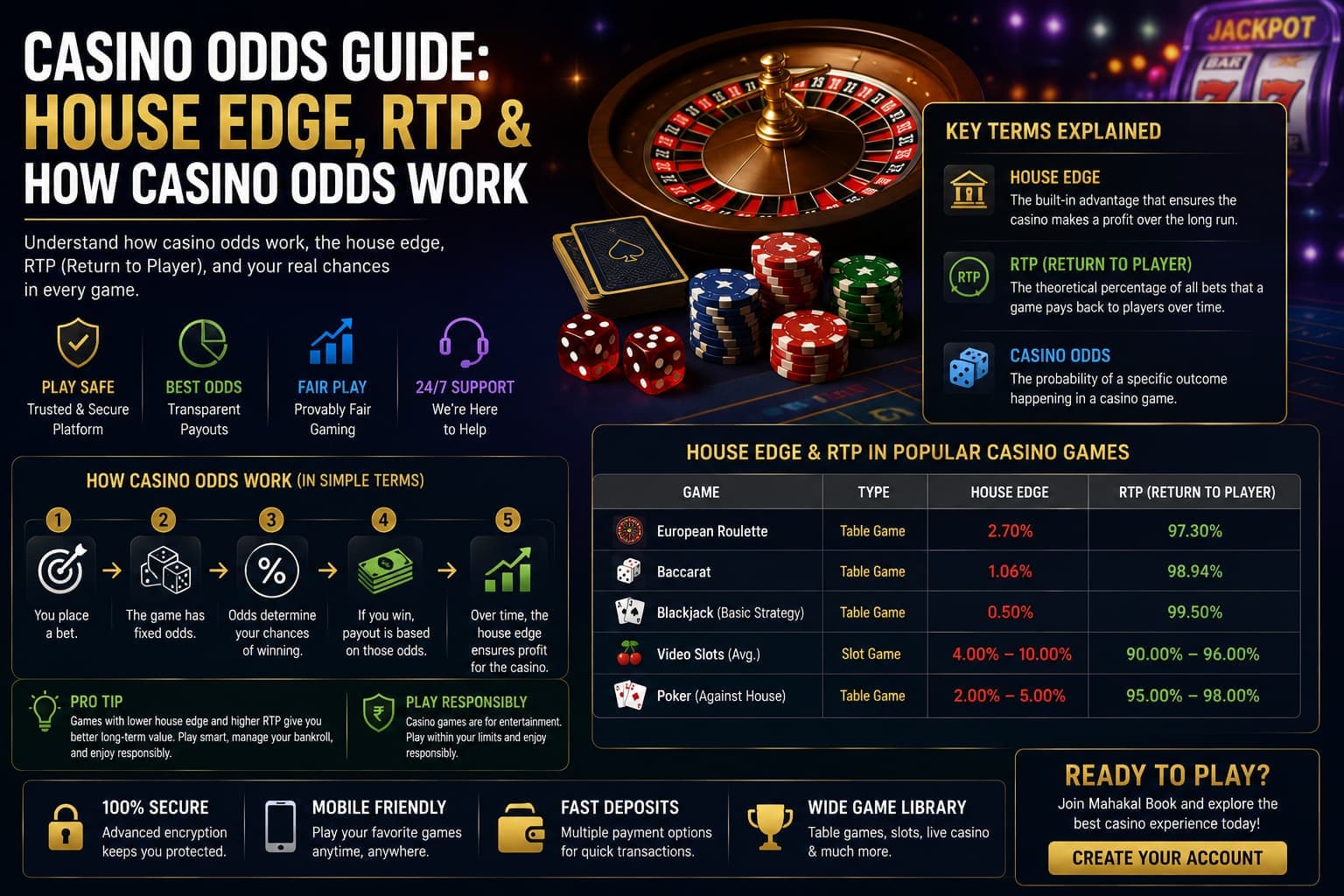
If you've ever wondered why some casino games seem easier to win than others, understanding casino odds is the best place to start. Whether you're playing Blackjack, Roulette, Baccarat, Teen Patti, or other popular casino games, every game is based on mathematical probabilities that influence the possible outcomes.
Casino odds represent the likelihood of different results occurring during gameplay. They also determine how payouts are calculated and explain why no casino game guarantees consistent winnings. Learning how odds work helps players understand the relationship between probability, risk, and potential returns, making it easier to make informed decisions.
In this guide, you'll learn what casino odds are, how they work, what the house edge means, how Return to Player (RTP) affects different games, and why understanding these concepts is important for anyone interested in casino gaming.
What are casino odds?
Casino odds describe the mathematical probability of a particular outcome occurring in a casino game. They help determine the likelihood of winning or losing a round and influence how much a game pays when certain results occur.
Every casino game is built around probability. Whether a game uses cards, dice, wheels, or random number generators (RNGs), the outcome is determined by mathematical rules rather than chance alone.
For example:
- A Roulette wheel has a fixed number of pockets.
- Blackjack follows a standard deck of cards.
- Baccarat uses predetermined card values.
- Poker depends on card combinations.
- Teen Patti is played using a standard 52-card deck.
Because every game has its own rules and probabilities, the odds vary from one game to another.
In simple terms:
Casino odds explain how likely a particular result is and help determine the corresponding payout.
Understanding these odds allows players to better understand how different casino games function rather than relying solely on luck.
Why casino odds matter
Casino odds help players understand the level of risk involved in different games and provide a clearer picture of how payouts are determined. While odds cannot predict the outcome of an individual round, they explain the long-term mathematical expectations built into every casino game.
Here are several reasons why understanding casino odds is important.
Better understanding of game mechanics
Every casino game follows a unique set of rules and probabilities. Learning the odds helps players understand why some games have more favourable outcomes than others.
More informed decision-making
When players understand the relationship between probability and payouts, they can compare different games more effectively instead of making decisions based only on assumptions.
Realistic expectations
Casino odds demonstrate that every game contains uncertainty. Understanding this helps players avoid unrealistic expectations and recognise that short-term results may differ from long-term probabilities.
Comparing different casino games
Different games have different mathematical structures.
For example:
- Blackjack generally has a relatively low house edge when basic strategy is followed.
- Baccarat offers different odds depending on the type of wager.
- Roulette odds vary depending on whether you're playing European or American Roulette.
- Teen Patti and Poker rely on card probabilities combined with player decision-making.
Learning these differences helps players understand why one game may present different probabilities than another.
Understanding payouts
Higher payouts don't always mean better odds.
Some bets offer large potential returns because the probability of winning is much lower. Others provide smaller payouts because winning outcomes occur more frequently.
Understanding this relationship is one of the most important concepts in casino gaming.
How casino odds work
Casino odds are based on probability. Every possible outcome in a game has a mathematical likelihood, and the casino uses these probabilities to determine payouts while maintaining a statistical advantage over the long term.
Four key concepts explain how casino odds work.
Probability
Probability measures the likelihood of a particular event occurring.
For example:
If a game offers two equally likely outcomes, each outcome has a probability of 50%.
If one outcome is much less likely, its probability decreases, but the potential payout may increase accordingly.
Casino games use these probabilities to calculate winning chances for every available wager.
Payouts
Payouts represent the amount returned to a player after a successful outcome.
Generally:
- Lower probability outcomes may offer higher payouts.
- Higher probability outcomes often provide smaller payouts.
For example, correctly predicting a rare outcome in Roulette usually pays significantly more than a simple even-money wager because it occurs less frequently.
It's important to understand that payouts are influenced not only by probability but also by the casino's operating model.
House edge
The house edge is the mathematical advantage built into every casino game.
It represents the percentage of each wager that the casino expects to retain over an extended period of play.
For example:
If a game has a 2% house edge, the long-term theoretical expectation is that the casino retains approximately ₹2 for every ₹100 wagered across many rounds of play.
This does not mean a player loses exactly 2% every session. Individual outcomes vary significantly because casino games involve short-term randomness.
The house edge becomes meaningful only over a very large number of rounds.
Return to Player (RTP)
Return to Player (RTP) is closely related to the house edge.
RTP represents the theoretical percentage of wagered money that a game returns to players over the long term.
For example:
- RTP of 98%
- House edge of 2%
These two values complement each other.
A higher RTP generally indicates a lower theoretical house edge, while a lower RTP indicates that the casino retains a larger percentage over time.
Like the house edge, RTP describes long-term statistical behaviour rather than guaranteeing any individual result.
Key takeaway: Casino odds, probability, payouts, house edge, and RTP all work together to explain how casino games function. Understanding these concepts provides a solid foundation before exploring the odds of individual games.
Casino odds in popular games
Every casino game follows its own mathematical structure, which means the odds, payouts, and level of risk vary from one game to another. Some games rely almost entirely on probability, while others also involve player decisions that can influence the overall outcome.
Understanding how odds differ across games can help you better understand how each game works and what to expect before you begin playing.
Blackjack odds
Blackjack is widely recognised as one of the casino games with a relatively low house edge when played using basic strategy. The objective is to build a hand value as close to 21 as possible without exceeding it, while also beating the dealer's hand.
Unlike games that depend entirely on chance, Blackjack allows players to make decisions throughout the game, such as whether to:
- Hit
- Stand
- Double Down
- Split pairs
- Surrender (where available)
Because these decisions affect the outcome, player strategy plays a significant role alongside probability.
What influences Blackjack odds?
Several factors can affect the mathematical odds in Blackjack, including:
- Number of decks in use
- Specific table rules
- Dealer rules
- Player decisions
- Availability of options like surrender or double down
Learning basic strategy doesn't guarantee winning individual hands, but it can help players make mathematically informed decisions over the long term.
Roulette odds
Roulette is one of the simplest casino games to understand because every wager has clearly defined probabilities and payouts. The game is played using a spinning wheel with numbered pockets, and players place bets on where they believe the ball will land.
Roulette offers different categories of bets, including:
- Straight number bets
- Red or Black
- Odd or Even
- High or Low
- Columns
- Dozens
Each wager carries a different probability and corresponding payout.
European vs American Roulette
The type of Roulette wheel affects the overall odds.
European Roulette uses a single zero (0), while American Roulette includes both a single zero (0) and a double zero (00).
Because of the additional pocket, American Roulette generally has a higher house edge than European Roulette.
This is why many experienced players prefer European Roulette when both versions are available.
Baccarat odds
Baccarat is a straightforward card game that compares two hands: the Player and the Banker. Players do not compete against each other but instead choose which hand they believe will have the higher value or whether the result will be a tie.
Most Baccarat games offer three primary betting options:
- Player
- Banker
- Tie
Each option has its own probability and payout structure.
Understanding Baccarat probabilities
The Banker and Player wagers generally have higher probabilities than the Tie wager.
Although the Banker bet usually includes a commission in many versions of the game, it is often considered to have one of the lower house edges available in casino gaming.
The Tie bet offers a larger payout but occurs much less frequently, resulting in a higher level of risk.
Poker odds
Poker differs from most traditional casino games because player decisions have a much greater influence on the outcome. Success depends not only on the cards dealt but also on understanding probability, reading situations, and making informed strategic decisions.
Important concepts in Poker include:
- Hand probabilities
- Pot odds
- Expected value
- Position
- Betting strategy
Unlike games based entirely on random outcomes, Poker rewards long-term decision-making and mathematical thinking.
Because different Poker variants have different rules, the exact probabilities vary between games.
Teen Patti odds
Teen Patti is one of the most popular card games in India and is based on a standard 52-card deck. Each player receives three cards, and the strength of the hand determines the winner.
Hand rankings include:
- Trail (Three of a Kind)
- Pure Sequence
- Sequence
- Colour
- Pair
- High Card
Since stronger hands occur less frequently than weaker hands, the probabilities vary significantly between different hand rankings.
Understanding these probabilities can help players better appreciate how rare certain hands are, although each round remains independent and unpredictable.
Dragon Tiger odds
Dragon Tiger is known for its simple gameplay and quick rounds. The game uses two positions:
- Dragon
- Tiger
One card is dealt to each position, and the higher-value card wins.
Players generally choose:
- Dragon
- Tiger
- Tie
The Tie option usually offers a much higher payout because it occurs less frequently than either Dragon or Tiger winning.
This illustrates one of the fundamental principles of casino odds:
Lower probability outcomes generally offer larger potential payouts.
Andar Bahar odds
Andar Bahar is another traditional Indian card game built around simple rules and straightforward probabilities.
The game begins with one card placed in the centre.
Additional cards are then dealt alternately to:
- Andar
- Bahar
The objective is to predict which side will receive the matching card first.
Because only one prediction is required, the game is relatively easy for beginners to understand.
However, the exact probabilities vary depending on the starting card and the remaining cards in the deck.
Aviator odds
Aviator is a multiplier-style game that differs significantly from traditional card and table games. Instead of predicting cards or numbers, players decide when to cash out before the multiplier stops increasing.
The game is based on a random outcome generated independently for each round.
Several factors influence the overall experience:
- Random multiplier values
- Cash-out timing
- Individual player decisions
Since every round is independent, previous multipliers do not affect future results.
It's important to understand that no betting pattern or prediction method can guarantee future outcomes.
Key takeaway
Every casino game has its own mathematical structure.
Some games, such as Blackjack and Poker, allow player decisions to influence long-term outcomes, while others rely primarily on fixed probabilities.
Learning how these games differ helps players better understand:
- Probability
- Risk
- Payout structures
- House edge
- RTP
- Strategic decision-making
This knowledge provides a stronger foundation before exploring more advanced concepts like house edge and Return to Player (RTP).
House edge vs Return to Player (RTP)
House edge and Return to Player (RTP) are two of the most important concepts in casino gaming. While they describe the same mathematical relationship from different perspectives, understanding the difference helps explain how casino games are designed.
Simply put:
- House edge represents the casino's theoretical long-term advantage.
- RTP represents the theoretical percentage of wagers returned to players over an extended period.
These values are based on millions of simulated or real game rounds and are not predictions of what will happen during an individual gaming session.
What is the house edge?
The house edge is the built-in mathematical advantage that allows a casino game to remain sustainable over time.
For example, if a game has a 3% house edge, the theoretical expectation is that the casino retains approximately ₹3 for every ₹100 wagered over a very large number of rounds.
This doesn't mean every player loses ₹3 for every ₹100 played.
Instead:
- Some sessions may end with wins.
- Some sessions may end with losses.
- Short-term results vary because outcomes remain random.
The house edge becomes meaningful only when viewed across thousands or millions of game rounds.
What is RTP?
Return to Player (RTP) represents the theoretical percentage of all wagers that a game returns to players over the long term.
For example:
- RTP: 97%
- House Edge: 3%
These two values complement each other.
If a game returns 97% over the long term, the remaining 3% represents the casino's theoretical advantage.
Like the house edge, RTP is a statistical measure rather than a guarantee for any individual player.
House edge vs RTP: What's the difference?
Although they describe the same mathematical relationship, they focus on different perspectives.
- House edge looks at the casino's expected advantage.
- RTP looks at the percentage theoretically returned to players.
For example:
- RTP = 96%
- House Edge = 4%
Both figures describe the same game but from opposite viewpoints.
Understanding both terms makes it easier to compare different casino games and understand how their mathematical models work.
Which casino games generally offer better odds?
Different casino games have different mathematical structures, which means some games may have lower theoretical house edges than others. However, game rules, software providers, and player decisions can all influence the overall experience.
Generally speaking:
Blackjack
When basic strategy is followed, Blackjack is often recognised as one of the casino games with a relatively low theoretical house edge.
Player decisions play an important role, making strategy more influential than in many other casino games.
Baccarat
Many Baccarat variations offer relatively favourable mathematical odds on the Banker and Player wagers.
The Tie wager typically offers a much larger payout but occurs less frequently, resulting in a higher level of risk.
European Roulette
European Roulette uses a single zero wheel, resulting in a lower theoretical house edge than American Roulette, which includes both a single zero and a double zero.
For this reason, many experienced players prefer European Roulette when both versions are available.
Poker
Poker differs because players compete against one another rather than solely against the casino.
Long-term results depend heavily on:
- Skill
- Probability
- Decision-making
- Experience
- Strategy
This makes Poker fundamentally different from games based entirely on fixed probabilities.
Teen Patti
Teen Patti combines probability with player decisions and psychology.
While every hand follows mathematical probabilities, strategic decisions can influence gameplay throughout a session.
Remember
No casino game guarantees better outcomes.
Even games with lower theoretical house edges still involve uncertainty, and short-term results remain unpredictable.
Understanding probability is more valuable than trying to identify a "winning" game.
Common misconceptions about casino odds
Many misconceptions about casino odds come from misunderstanding probability and randomness. Learning the facts can help players make more informed decisions.
"A game is due to pay soon."
One of the most common misconceptions is believing that previous outcomes influence future results.
For games based on independent random events, each round is separate.
For example:
If Roulette lands on black several times in a row, the next spin isn't more likely to land on red simply because black appeared repeatedly.
Each spin remains an independent event.
"Higher payouts mean better odds."
A large payout often reflects a lower probability of that outcome occurring.
For example:
A rare Roulette bet offers a higher payout because it is statistically less likely to happen than an even-money wager.
Higher rewards generally come with higher levels of risk.
"Winning streaks always continue."
Some players believe that a series of wins indicates more wins are likely.
In reality, independent casino games don't have memory.
Past results do not influence future random outcomes.
"There is a guaranteed winning strategy."
Many systems claim to guarantee consistent winnings.
However, no betting system can eliminate the mathematical uncertainty built into casino games.
Understanding probability is far more useful than relying on claims of guaranteed success.
"RTP guarantees my results."
RTP describes theoretical long-term performance.
It does not predict the outcome of:
- Your next round
- Today's session
- This week's gameplay
Short-term results will always vary.
Tips for understanding casino odds
Learning a few basic principles can make casino odds much easier to understand.
Learn the rules before playing
Every casino game follows its own rules and probability model.
Understanding how a game works is the first step toward understanding its odds.
Focus on probability, not predictions
Casino odds describe mathematical likelihoods rather than guaranteed outcomes.
Thinking in terms of probability helps create more realistic expectations.
Compare different games
Every casino game has its own:
- Probability
- RTP
- House edge
- Payout structure
Comparing these factors provides a better understanding than looking only at potential payouts.
Don't rely on myths
Many popular casino myths have no mathematical basis.
Avoid making decisions based on:
- Hot streaks
- Lucky numbers
- Betting systems claiming guaranteed success
- Previous game outcomes
Instead, focus on learning how probability actually works.
Play for entertainment
Casino games are designed to provide entertainment.
Understanding the mathematics behind them can improve your knowledge, but no strategy removes the element of chance.
Play responsibly
Casino gaming should always be approached responsibly and viewed as entertainment rather than a guaranteed way to make money. Understanding casino odds can help set realistic expectations, but it cannot predict individual outcomes or eliminate uncertainty.
For a balanced gaming experience:
- Set a personal spending budget before you begin.
- Decide how much time you want to spend playing.
- Never chase previous losses by increasing your wagers.
- Take regular breaks during longer gaming sessions.
- Learn the rules and probabilities before trying a new game.
- Keep your account information secure and use trusted platforms.
- Stop playing if gaming begins affecting your finances, work, or personal life.
Responsible gaming is about staying informed, maintaining control, and enjoying casino games within limits that are comfortable for you.
Key takeaways
Before moving to the FAQs, remember these important points:
- Casino odds are based on mathematical probability.
- Every casino game has its own odds, RTP, and house edge.
- Higher payouts usually correspond to lower-probability outcomes.
- RTP and house edge describe long-term expectations, not individual sessions.
- Understanding probability helps you make informed decisions but cannot predict future results.
- No betting system or strategy can guarantee consistent winnings.
- Responsible gaming should always be your priority.
Conclusion
Understanding casino odds is one of the most valuable steps toward learning how casino games work. Whether you're exploring Blackjack, Roulette, Baccarat, Poker, Teen Patti, Dragon Tiger, Andar Bahar, or Aviator, every game is built on mathematical probabilities that influence outcomes, payouts, and long-term expectations.
Learning concepts such as probability, house edge, and Return to Player (RTP) won't predict future results, but it will help you better understand the mechanics behind different casino games. This knowledge allows you to compare games more effectively, recognise common misconceptions, and make informed decisions based on facts rather than myths.
As you continue learning about casino gaming, remember that every session is unique. Understanding the mathematics behind casino games can improve your knowledge, but responsible gaming and realistic expectations should always remain your priority.